The Day the Sky Fell
February 1, 2003 – 8:59 AM EST
Mission Control was all routine chatter until it wasn’t.
“Columbia, Houston, comm check.”
Silence.
“Columbia, Houston, UHF comm check.”
More silence.
On the giant screens, 37 green telemetry streams from STS-107 blinked red, then vanished. For 84 terrifying seconds, controllers clung to hope – maybe a communication glitch, perhaps the shuttle had entered a blackout zone.
Then the phone rang. A farmer in Nacogdoches, Texas was on the line. “I think,” he said, voice trembling, “you’ve got a problem. There’s debris falling from the sky.”
Seven astronauts were gone. The space shuttle Columbia had disintegrated during re-entry, scattering wreckage across two states. A nation watched in horror as the unthinkable unfolded on live television.
But this story isn’t about the tragedy. It’s about the investigation that followed – an investigation that would hinge on something most people had never heard of: Computational Fluid Dynamics. This is the story of how a simulation, running on supercomputers a thousand miles from the crash site, helped solve one of NASA’s greatest mysteries and fundamentally changed how we explore space.
The Smoking Gun in Slow Motion
Three weeks earlier, during Columbia’s launch on January 16, engineers reviewing launch footage noticed something troubling. At 81.7 seconds after liftoff, a suitcase-sized chunk of foam insulation broke off from the external fuel tank’s “bipod ramp” area.
The foam – about 20 by 16 by 6 inches, weighing roughly 1.67 pounds – traveled forward and upward before striking the leading edge of Columbia’s left wing at approximately 500 miles per hour.
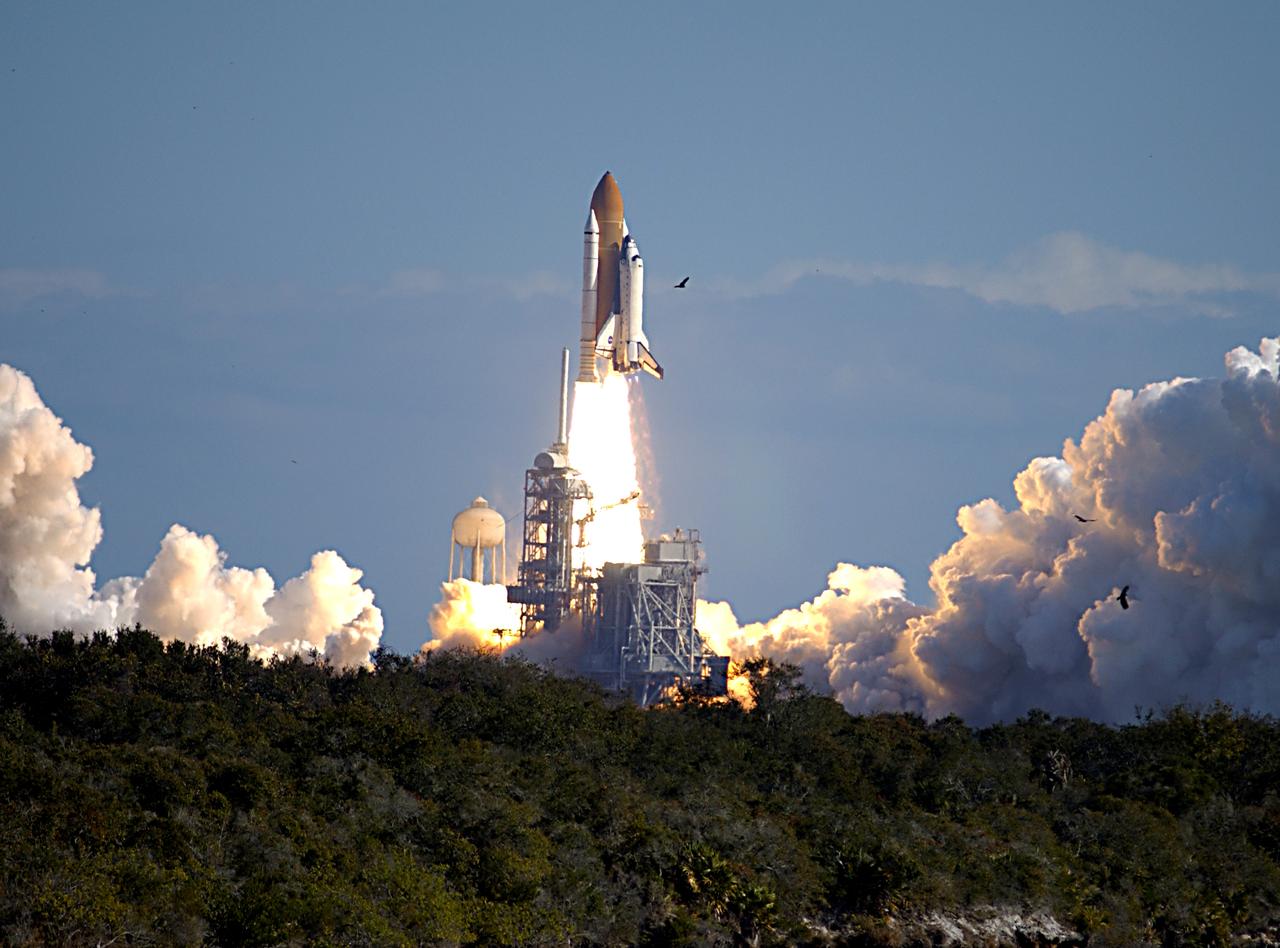
Space Shuttle Columbia launching on its final mission (Credit: NASA)
At the time, the attitude was dismissive. “It’s just foam,” one manager reportedly said. “We’ve seen this before.” And they had – foam shedding was a known issue, documented in 65 of 79 previous shuttle missions. But never from the bipod area, and never with consequences imagined.
Except three engineers weren’t convinced. Their emails in the days following would become haunting artifacts:
“I’m afraid that everyone will be so happy to be safe on the ground that they will ignore what happened…”
“…I really don’t think we’ll know if there was damage unless we get a look at it in orbit.”
Their requests for satellite imagery of the damaged wing were denied. The official stance: even if there was damage, nothing could be done about it in orbit anyway.
The Digital Autopsy Begins
On February 2, 2003 – one day after the disaster – NASA formed the Columbia Accident Investigation Board (CAIB). They faced an unprecedented challenge: reconstruct a failure that occurred at Mach 18, 200,000 feet above Earth, with no surviving hardware from the critical failure point.
Enter Dr. Scott Hubbard and his team at NASA Ames Research Center. Their task: determine if a piece of foam could actually breach the shuttle’s Thermal Protection System (TPS).
The shuttle’s leading edge was protected by Reinforced Carbon-Carbon (RCC) panels – a material designed to withstand temperatures up to 3,000°F. The foam, meanwhile, was polyurethane-based insulation sprayed onto the external tank. The mismatch seemed absurd: soft foam versus space-grade composite.
But as any CFD engineer knows, velocity changes everything.
The question wasn’t: “Can foam damage RCC?”
The real question was: “What happens when ANY object strikes another at 750 feet per second?”
That’s where CFD entered the picture.
Building the Virtual Crime Scene
The simulation team faced four monumental challenges:
- No physical testing could replicate the exact conditions – The relative velocity was simply too high for existing test facilities
- The materials behaved non-linearly – Both foam and RCC had complex failure modes
- They needed to model multi-physics – Solid mechanics, fluid dynamics, and material failure all interacting
- Time pressure – The remaining shuttle fleet was grounded, and answers were needed immediately
🔬 Simulation Parameters (Simplified)
| Parameter | Value | Significance |
|---|---|---|
| Impact Velocity | 750 ft/s (228 m/s) | Relative speed at impact |
| Impact Angle | 20° from horizontal | Determines stress distribution |
| Foam Density | 2.4 lb/ft³ (38.5 kg/m³) | Closed-cell polyurethane |
| RCC Tensile Strength | 45,000 psi | Carbon-carbon composite strength |
| Stagnation Pressure | ~2,000 psi | “Water hammer” effect from compressed air |
What made this simulation particularly challenging was the multi-scale nature of the problem. They needed to resolve:
- Macro: The overall wing structure (meters)
- Meso: The foam deformation (centimeters)
- Micro: The RCC fiber-matrix failure (millimeters)
All while tracking shock waves propagating through multiple materials.
The “Oh No” Moment
When the simulation results came in, they were worse than anyone had imagined.
The visualization showed something counterintuitive: the foam itself wasn’t the primary damaging agent. Instead, the compressed air trapped between the foam and the wing acted like a hydraulic ram, transmitting pressure waves into the RCC panel.
Here’s what happened in milliseconds:
- 0.0 ms: Foam makes initial contact
- 0.2 ms: Shock wave propagates through RCC
- 0.5 ms: Tensile stresses exceed material strength on back side
- 1.2 ms: Crack propagates completely through 0.5-inch thick panel
- 3.0 ms: Debris cloud forms behind the panel
The simulation predicted a hole 6-10 inches in diameter – more than enough for superheated plasma to enter during re-entry.

Time snap-shots showing the impact event (Credit: The Use of LS-DYNA in the Columbia Accident Investigation and Return to Flight Activities – Scientific Figure on ResearchGate. Available from: https://www.researchgate.net/figure/Time-snap-shots-showing-the-impact-event_fig3_250145655)
But simulations need validation. The team turned to an ingenious physical test: they built a compressed air cannon at Southwest Research Institute in San Antonio. Using the simulation parameters as a guide, they fired foam projectiles at actual RCC panels.
The first test created a hole 16 inches wide.
The correlation was terrifyingly precise. The simulation had captured reality with remarkable accuracy.
Connecting the Dots: From Simulation to Disaster
With the physics confirmed, investigators could reconstruct Columbia’s final minutes:
Re-entry begins over Pacific Ocean
First temperature sensor anomalies in left wing
Multiple sensors fail; plasma enters wing structure
Loss of control; structural disintegration begins
The debris recovery effort told the same story. When investigators found RCC panel #8 – the one the simulation predicted would fail – it showed clear impact damage consistent with the CFD predictions.
The simulation had provided something invaluable: not just what happened, but why it happened. This distinction would prove crucial for fixing the problem.
The Legacy: How CFD Changed Spaceflight Forever
Immediate Changes (2003-2005):
- Fleet grounding – All shuttles grounded for 29 months
- In-orbit inspection – Mandatory RCC inspection using the Orbiter Boom Sensor System
- Launch cameras – Dozens of new cameras covering every angle of launch
- Foam application redesign – New procedures eliminated bipod ramp foam entirely
Cultural Shift at NASA:
- “Prove it’s safe” replaced “Prove it’s unsafe” as the safety philosophy
- CFD became mandatory for all critical risk assessments
- Independent verification required for all flight-critical analyses
Technical Advances in CFD:
The Columbia investigation accelerated several CFD developments:
- Multi-physics coupling – Better fluid-structure interaction methods
- Material modeling – Advanced failure criteria for composites
- Uncertainty quantification – Statistical approaches to simulation confidence
- High-performance computing – NASA’s investment in supercomputing surged
Perhaps most importantly, the investigation established a new principle: when physical testing is impossible, validated simulations become engineering necessity, not academic exercise.
A Personal Reflection from a CFD Engineer
As someone who spends days staring at convergence plots and mesh quality metrics, the Columbia story hits differently. We sometimes joke about “garbage in, garbage out” or debate the merits of different turbulence models. But this story reminds me that our work has real consequences.
That mesh we’re refining? It might represent an aircraft wing, a heart valve, or a hurricane path. Those convergence criteria we set? They might determine whether we catch a failure mode or miss it.
The Columbia engineers didn’t have the computing power we take for granted today. They ran their simulations on what we’d now consider ancient hardware. Yet their results were accurate enough to reconstruct a disaster and prevent future ones.
It’s a humbling reminder: Good CFD isn’t about having the fastest computer or the fanciest software. It’s about asking the right questions, understanding the physics, and having the courage to trust the numbers even when they tell an uncomfortable truth.
Quick Thought Experiment:
Take a styrofoam cup. Tap it gently – nothing happens. Now imagine that same cup hitting you at highway speed. The material hasn’t changed, but the energy has increased with the square of velocity. That’s the key insight the CFD revealed: at sufficient speed, anything can become a projectile.
Energy = ½ × mass × velocity²
Double the velocity, quadruple the energy. That 1.67 lb foam chunk at 500 mph carried the same kinetic energy as a 20 lb weight dropped from a 4-story building.
📚 Recommended Reading:
- Columbia Accident Investigation Board Report – The complete official investigation
- “Bringing Columbia Home” by Michael Leinbach – The untold story of the recovery operation
- NASA’s Engineering Lessons Learned Database – Public repository of technical findings
🎥 Documentaries:
- “The Space Shuttle that Fell to Earth” – Investigative documentary(BBC)
- “Columbia: The Final Flight” (Netflix) – Comprehensive four-part series
- NASA’s STS-107 Memorial Archive – Official NASA tribute
Discussion Questions
- Ethical consideration: If you were an engineer who suspected wing damage but couldn’t prove it, what would you have done differently?
- Technical challenge: What additional simulations would you run today with modern computing power?
- Professional reflection: How has this case study changed your view of simulation validation?
Share your thoughts in the comments below!