Utsav Purkait
I study turbulence modelling and vortex dynamics — specifically where physical models succeed and where they structurally fail. Based at IIT Bombay, my work spans RANS anisotropy diagnosis in free-shear jets and high-fidelity LES of wall-bounded turbulent flows.

-
Research Assistant — IIT Bombay Studying RANS anisotropy in turbulent free-shear jets, and setting up a three-dimensional LES of a turbulent wall jet in OpenFOAM — extending the diagnostic work to a more complex coupled boundary-layer and free-shear-layer flow.
-
Writing on Turbulent Thoughts Publishing in-depth articles on CFD, turbulence modelling, and the mathematics of fluid mechanics — for engineers who want the full picture.
What I work on
-
RANS anisotropy & LES of turbulent jets
Diagnosing structural failure modes of RANS closure in turbulent free-shear jets, then extending the work to LES of a turbulent wall jet in OpenFOAM — a more complex flow coupling a boundary layer with a free-shear layer.
-
Tornado-like vortex flow simulator
Designed and simulated a dual-shell simulator replicating Rankine vortex dynamics. Physical experiments on the fabricated model confirmed CFD predictions to within 8.5%.
-
Data-driven turbulence closure
Exploring symbolic regression and hybrid neural–algebraic models as interpretable routes to RANS closure — machine learning that produces physics.
Featured
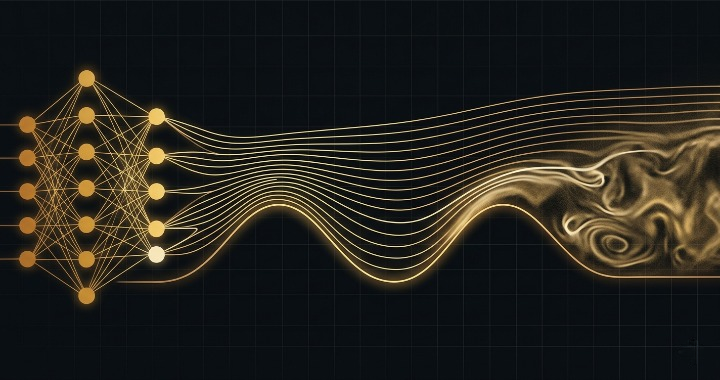
Data-driven turbulence models often fail when deployed in RANS solvers due to distribution shift. This review examines DARSM, a hybrid model that uses neural networks to calibrate physics-based algebraic equations. By ensuring consistency between training and deployment, DARSM improves generalization across complex flows while highlighting the structural limits…
More articles

Can ML Discover a Better Turbulence Model? A New Fix to Spalart-Allmaras for Separated Flows
A review of Bataillie, Casanova & Volpiani, “Improving the Spalart-Allmaras turbulence model for separated flows using field inversion and symbolic regression,” Phys. Rev. Fluids…
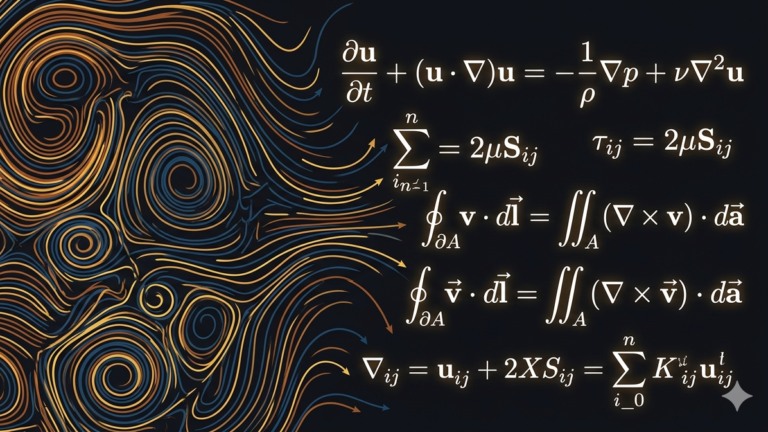
Can a Machine Discover a Turbulence Model? The Rise of Symbolic Regression in RANS Closure
There’s a quiet revolution happening at the intersection of machine learning and turbulence modelling, and it doesn’t look like what most people expect. It…

Rortex: finally, a vortex vector that means what it says
Traditional fluid dynamics often confuses vorticity with actual rotation, leading to inaccurate vortex identification. The Rortex method solves this by isolating rigid-body rotation from…
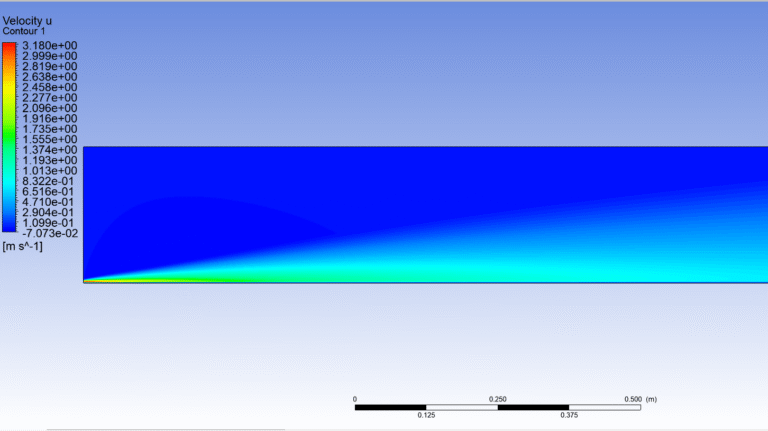
Structural Limits of Linear Eddy-Viscosity Models in the Planar Jet
This article examines the validation of planar turbulent jet simulations, highlighting how key metrics like jet spreading and decay laws align with direct numerical…
When pressure-based solvers silently break conservation
Okay, real talk for a minute. Last month, I almost submitted a paper with results that were mathematically beautiful and physically impossible. My pressure-based solver…
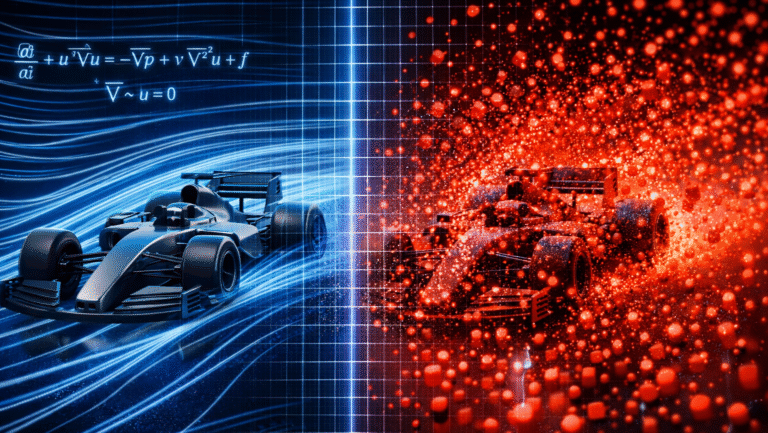
“The Boltzmann Gambit” – When Particle Kinetics Challenges Continuum Mechanics
The “collide-and-stream” algorithm seemed too simple to be revolutionary. In 1998, when Exa Corporation first commercialized the Lattice-Boltzmann Method (LBM), traditional CFD engineers dismissed it…
The Playground
Test your knowledge with topic-specific quizzes, watch curated CFD explainer videos, and challenge yourself across five difficulty categories.
Enter playground →