Numerical Methods and Stability
Explores the mathematical foundations of solving fluid dynamics equations computationally — discretisation schemes, finite volume and finite difference methods, numerical stability, convergence criteria, truncation error, and mesh independence. Essential reading for anyone building or validating CFD simulations.

Rortex: finally, a vortex vector that means what it says
Traditional fluid dynamics often confuses vorticity with actual rotation, leading to inaccurate vortex identification. The Rortex method solves this by isolating rigid-body rotation from…
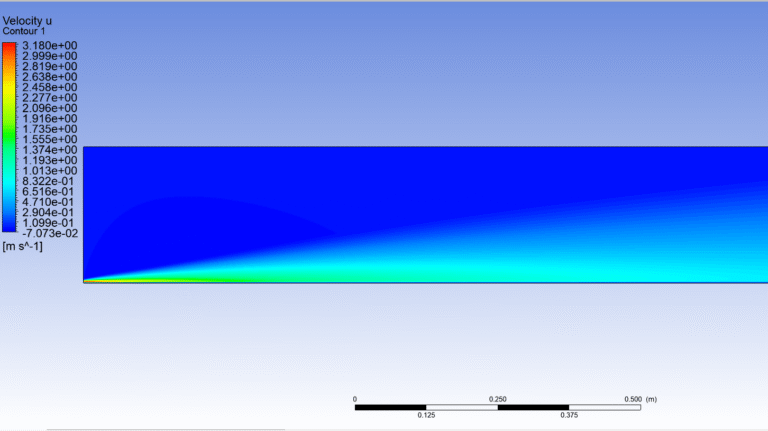
Structural Limits of Linear Eddy-Viscosity Models in the Planar Jet
This article examines the validation of planar turbulent jet simulations, highlighting how key metrics like jet spreading and decay laws align with direct numerical…

When pressure-based solvers silently break conservation
Okay, real talk for a minute. Last month, I almost submitted a paper with results that were mathematically beautiful and physically impossible. My pressure-based solver…
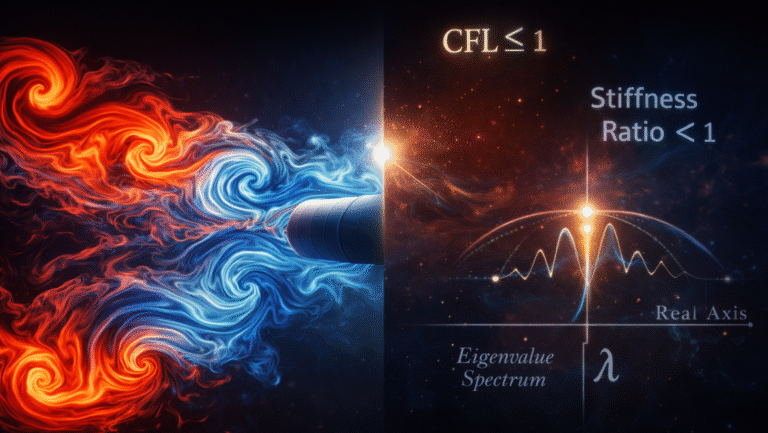
Time-Step Independence Is Not What You Think It Is: The Stiffness vs. CFL Trap
I was simulating vortex shedding behind a cylinder at Re = 100. My explicit compressible solver gave plausible results at Δt = 1e-5 seconds,…

The Complete CFD Meshing Guide
The uncomfortable truth: 80% of your simulation’s success depends on mesh quality. Most engineers spend 20% of their time on it. This guide fixes…
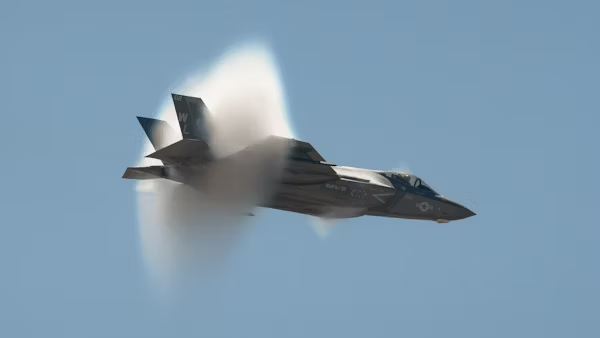
Taming the Sonic Boom: A Guide to Shock Waves and Capturing Them in CFD
In our previous post on Mach Number, we talked about what happens when an object moves faster than the speed of sound: it outruns its…

Understanding Fluent Solvers: Pressure-Based vs. Density-Based – Which One to Choose?
Confused by Ansys Fluent solver options? Learn the key difference between Pressure-Based and Density-Based solvers and a simple guide to choose the right one…