
Confused by Ansys Fluent solver options? Learn the key difference between Pressure-Based and Density-Based solvers and a simple guide to choose the right one for your CFD simulation
You see these options right at the beginning when you set up your Fluent case. However, picking the wrong one can lead to a slow, unstable, or even non-converging solution. So, let’s break it down in simple terms.
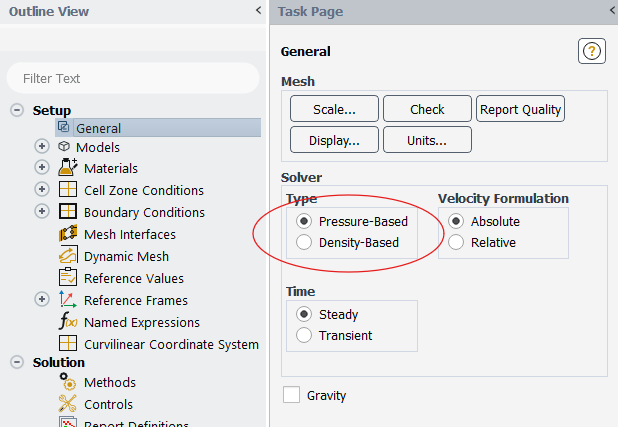
The Core Idea: What’s the Primary Variable?
The most fundamental difference lies in how each solver handles the core equations of fluid flow (the Navier-Stokes equations).
- The Pressure-Based Solver was originally developed for incompressible flows. Its main strategy is to first solve a “pressure equation,” which is derived from the continuity and momentum equations. Think of it as figuring out the pressure field that will make the velocity field mass-conserving. Once pressure is correct, it uses it to update the velocities.
- Analogy: It’s like solving a puzzle where you adjust the pressure to make all the flow pieces (velocity) fit together perfectly.

- The Density-Based Solver was originally developed for high-speed compressible flows. This solver tackles the momentum and continuity equations together, directly. In compressible flow, density is a strong function of pressure (via an equation of state). So, by solving the coupled system, it directly updates density, and then pressure and velocity are derived.
- Analogy: It’s a more direct, “brute-force” approach that solves for the fundamental properties (mass, momentum) all at once, which is necessary when they are tightly linked.

Here’s a simple table to summarize the historical and conceptual origins:
| Feature | Pressure-Based Solver | Density-Based Solver |
|---|---|---|
| Original Purpose | Incompressible Flow | Compressible Flow |
| Primary Variable | Pressure | Density |
| Solution Approach | Segregated (Solves for variables one by one) | Coupled (Solves for momentum & continuity together) |
But Wait, It’s Not That Simple Anymore!
The lines have blurred significantly in modern versions of ANSYS Fluent. The pressure-based solver has been enhanced to handle compressible flows very well, and the density-based solver can be used for incompressible flows.
So, the choice today is less about capability and more about efficiency and robustness for your specific problem.
The Million-Dollar Question: Which Solver Should I Choose?
Here is a practical guide. For most common applications, you can’t go wrong with this logic:
✅ Choose the PRESSURE-BASED Solver for:
- Incompressible & Mildly Compressible Flows: This is its home turf. It’s typically faster and more robust for these cases.
- Examples: Water flow in pipes, air flow over a car at low speeds (< Mach 0.3), HVAC systems, external aerodynamics of buildings, mixing tanks.
- Buoyancy-Driven Flows (Natural Convection): It handles the strong linkage between pressure and momentum very effectively.
- Flows with Complex Physics: If you have many additional models activated (like detailed chemistry, multiphase, etc.), the segregated approach of the pressure-based solver can be more stable.
✅ Choose the DENSITY-BASED Solver for:
- High-Speed Compressible Flows: This is where it truly shines and is often more accurate and efficient.
- Examples: Supersonic and hypersonic flows (e.g., flow around a missile, scramjet inlets), shock waves, high-speed compressors and turbines.
- Problems with Strong Shock Waves: The coupled formulation is inherently better at capturing sharp discontinuities like shocks.
- Certain Transient Problems: Some users find the density-based solver converges faster for highly transient, high-speed events.
A Quick Look “Under the Hood” in Fluent
When you select the solver in Fluent, you’ll notice sub-options:

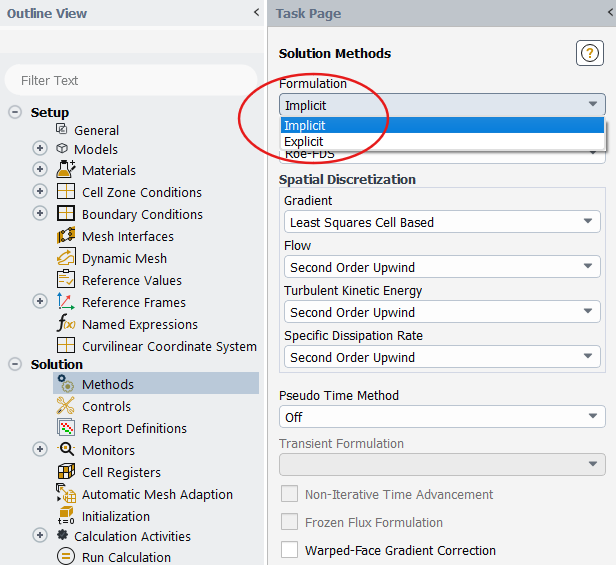
- For Pressure-Based:
- Coupled Scheme: A newer, more robust option. It couples pressure and velocity, leading to faster convergence for most steady-state flows. This is generally the recommended choice for pressure-based solves today.
- SIMPLE/SIMPLEC Schemes: The classic segregated algorithms. They are more memory-efficient and can be more stable for very complex, unstable flows.
- For Density-Based:
- Implicit vs. Explicit: Implicit is the default and is stable for a wider range of time steps. Explicit can be faster for certain transient problems with very small time steps.
The Bottom Line & My Recommendation
- When in doubt, start with the Pressure-Based solver and the “Coupled” scheme. It will efficiently handle probably 80% of all industrial CFD problems.
- Switch to the Density-Based solver if your flow is highly compressible (Mach > 0.5) or you know you have strong shock waves.
- If you’re unsure, you can sometimes run a quick test with both solvers on a coarse mesh. Monitor convergence and the results (e.g., drag force, pressure drop) to see which one settles to a sensible answer faster.
Understanding the philosophy behind these solvers empowers you to make an informed decision, leading to faster, more accurate simulations. Stop guessing, and start solving intelligently!
What has your experience been? Have you ever been burned by choosing the wrong solver? Let me know in the comments below!
Further Reading:


[…] Understanding Fluent Solvers: Pressure-Based vs Density-Based […]