🌊 Reynolds Number Without Equations: The Crowd vs. the River
Imagine you’re at a rock concert. Everyone’s entering the arena in neat lanes — calm, organized, no shoving. Suddenly, the headliner appears on stage. The crowd surges forward, pushing, colliding, moving unpredictably.
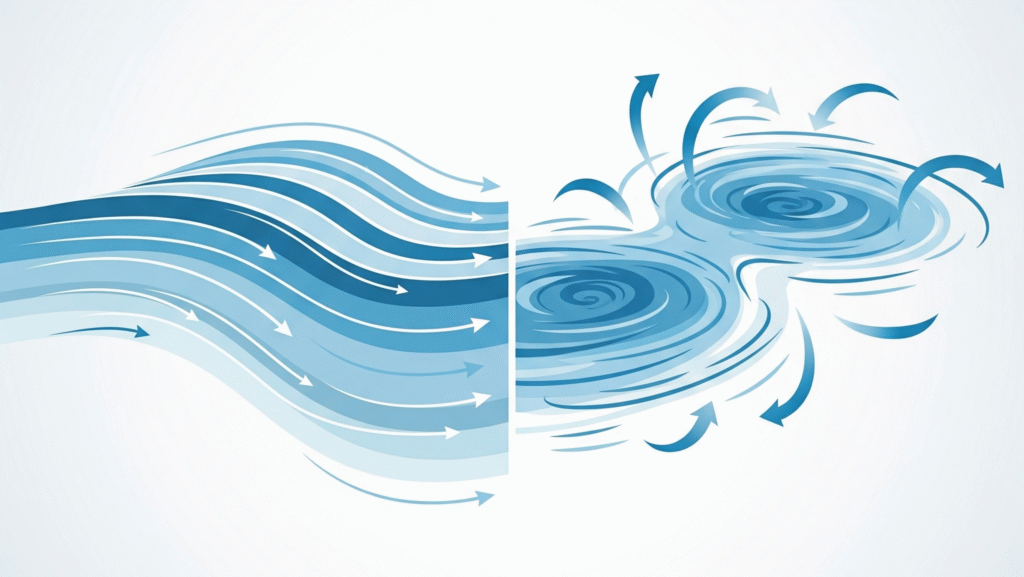
That moment of change — from order to chaos — is what the Reynolds number captures in fluid mechanics.
It’s the invisible referee that decides whether a fluid will behave like a disciplined classroom (laminar flow) or a chaotic playground (turbulent flow).
🪶 Laminar Flow: The Polite Crowd
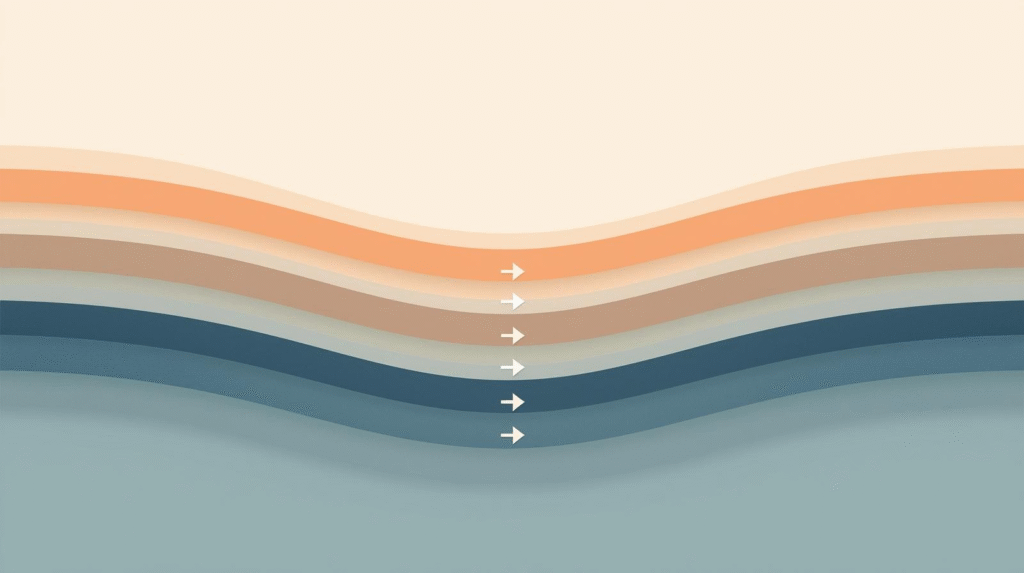
Think of tea gently poured into a cup. The liquid slides smoothly, layers gliding like sheets of silk, never disturbing each other. That’s laminar flow — predictable, stable, elegant.
- Analogy: People walking calmly on a sidewalk, each minding their lane.
- Example: Honey dripping from a spoon, or water flowing slowly in a thin straw.

🌪️ Turbulent Flow: The Chaotic Crowd
Now picture a river crashing over rocks. Swirls, eddies, and unpredictable currents form — it’s a lively mess. That’s turbulence.
- Analogy: A mosh pit at a concert — no one knows exactly where they’ll move next, but energy is everywhere.
- Example: Smoke rising from a candle that suddenly breaks into chaotic swirls.


⚖️ The Tipping Point: Crowd vs. River
The Reynolds number doesn’t care about equations in this explanation. Instead, think of it as the “crowd energy meter.”
- Low crowd energy → calm, organized, laminar.
- High crowd energy → collisions, swirls, turbulence.
And here’s the magic: once turbulence begins, it rarely goes back. Just like once the mosh pit starts, good luck calming it down.
Why Should You Care?
Because Reynolds number shows up everywhere:
- It decides whether blood flows smoothly in arteries or creates risky turbulence.
- It shapes how airplanes cut through air.
- It controls the efficiency of pipes, pumps, and engines.
It’s the hidden switch between order and chaos — and the reason engineers, doctors, and scientists pay so much attention to it.
✨ Fun Fact
Did you know? Osborne Reynolds tested this back in 1883 using a glass pipe, dyed water, and sheer curiosity. He probably had no idea his “crowd meter” would still be running the show today.
✅ Key Takeaway
Reynolds number is not just a number. It’s a story about balance — when smoothness breaks into chaos, when order gives way to unpredictability. You don’t need equations to feel it — just think of rivers, crowds, or even smoke above a candle.