Published: December 7, 2025 | Category: CFD Stories
We all know the grainy, terrifying footage: the Tacoma Narrows Bridge twisting and writhing like a living creature before its final plunge on November 7, 1940. For decades, the textbook explanation was simple: resonance. But what if the textbooks were wrong?
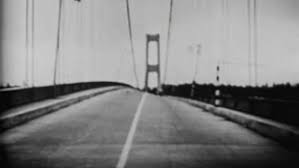
The iconic collapse of “Galloping Gertie” – November 7, 1940
The Flawed Design: An Aerodynamic Brick
The bridge’s deck was its fatal flaw. Its sleek, solid-girder “H” cross-section—11.9 meters wide but only 2.45 meters deep—was an aerodynamic brick. Compared to the open truss of the Golden Gate Bridge (span-to-depth ratio of 47:1), Tacoma’s 350:1 ratio was astronomically slender, offering minimal torsional stiffness.
Technical Snapshot: The Numbers Don’t Lie
- Wind Speed: 16-19 m/s (35-42 mph)
- Torsional Frequency: 0.2 Hz
- Critical Flutter Velocity (V_cr): 8-10 m/s
- Peak Torsion: 45° amplitude
- Mass per meter: 4250 kg/m
- Damping Ratio (ξ): 0.005 (critically low)
The Tipping Point: From Galloping to Death Spiral
Here’s where early explanations failed. Resonance implies an external force driving the oscillation at a fixed frequency. CFD simulations—using advanced turbulence models like LES and DES in tools like OpenFOAM and STAR-CCM+—show something more dangerous: self-excitation.
The simulations reveal the critical sequence:
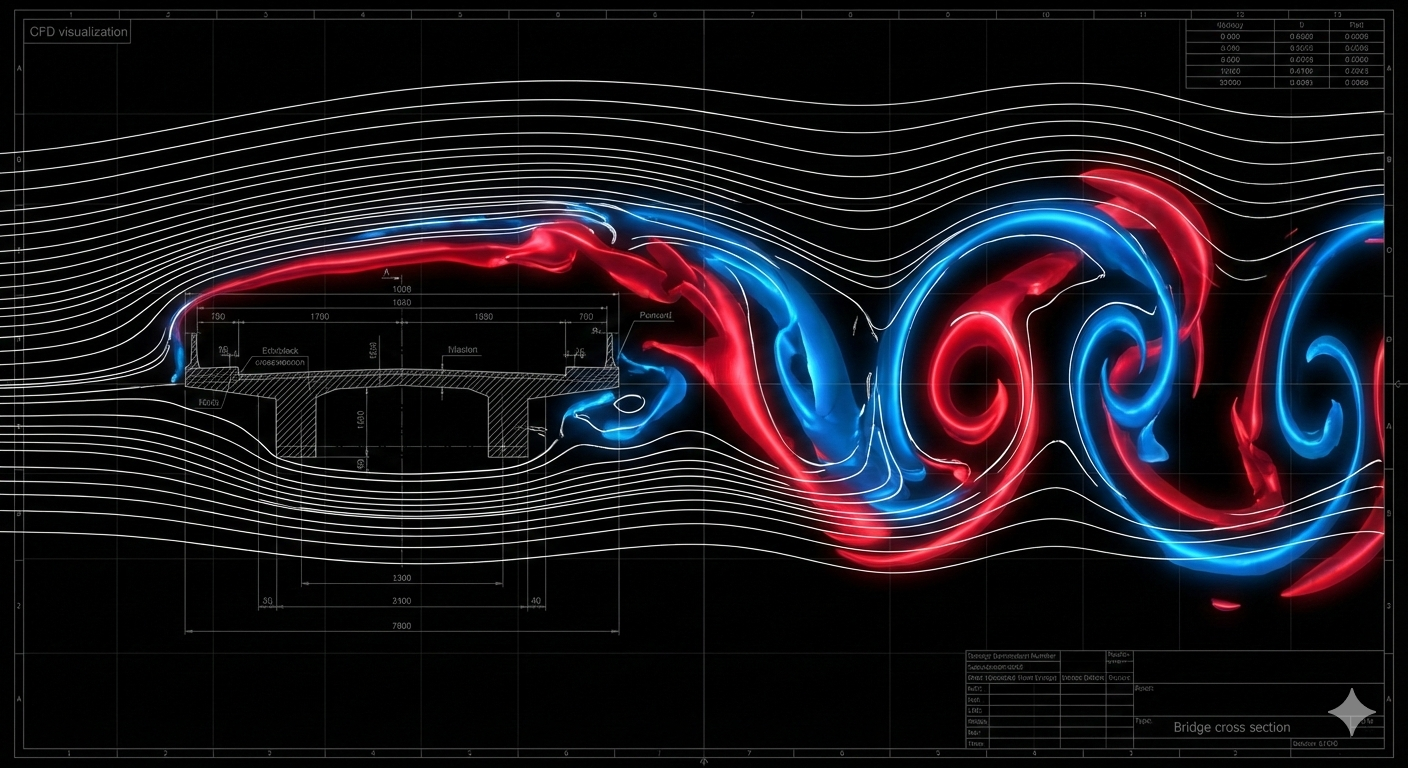
CFD reveals the Kármán vortex street and pressure differential driving torsional flutter
The Numerical Autopsy: Key CFD Findings
Critical Velocity Match
Simulations pinpoint flutter onset (V_cr) at 8-10 m/s—well below the actual wind speed. Once triggered, divergence was inevitable.
Energy Transfer Quantified
By integrating pressure over the simulated deck, engineers quantified the negative work—proving energy flowed from fluid to structure.
Historical Validation
The simulated frequency (0.2 Hz) and amplitude growth matched the 1940 footage with <2% error—validating against history’s worst full-scale test.
The Legacy: How CFD Redefined Bridge Design
The Tacoma Narrows collapse birthed modern bridge aerodynamics. Today, CFD isn’t a curiosity—it’s mandated in design codes for every major span.
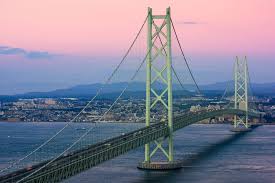
Modern bridges like Japan’s Akashi Kaikyō undergo exhaustive CFD testing before construction
- Pre-Construction Virtual Wind Tunnel: Bridges like the Great Belt are subjected to FSI (Fluid-Structure Interaction) simulations at full-scale Reynolds numbers, testing hundreds of wind scenarios before construction.
- Shape Optimization: Solid girders are gone. Modern decks are aerodynamically “tuned” with tapered edges, ventilation slots, and fairings that smooth streamlines and suppress vortex shedding (reducing C_M by 30%+).
- Rigorous Safety Factors: Designs must demonstrate flutter velocity (V_cr) ≥ 2x the worst-case wind speed. The Great Belt Bridge maintains V_cr = 63 m/s for 99.9% storm survivability.
Conclusion: From Forensic Tool to Proactive Shield
The story of Tacoma Narrows is no longer just about resonance. It’s a testament to CFD as a forensic time machine, revealing complex physics invisible in 1940.
“Every long span you cross today has had its dance with the wind choreographed in a virtual universe of equations—a direct legacy of Galloping Gertie’s final, tragic movements.”
Modern CFD-FEA workflows now mandate pre-construction FSI at full-scale Reynolds numbers, incorporating atmospheric boundary layers and shape optimization to ensure factor-of-safety > 2 against aeroelastic instability. The bridge that failed in 1940 now protects every bridge built since.
Further Reading & Technical References
- Scanlan, R.H. & Tomko, J.J. (1971). Airfoil and Bridge Deck Flutter Derivatives
- Larsen, A. (2000). Aerodynamics of the Tacoma Narrows Bridge
- CFD Studies: RNG k-ε, LES, DES turbulence models
- Modern Codes: Eurocode 1, AASHTO LRFD Wind Provisions
Technical models employ hybrid RANS-LES, dynamic meshing, and coupled Navier-Stokes/Newmark-β solvers [1,3,4]
📚 Recommended Reading:
- Computational Fluid Dynamics Model for Tacoma Narrows Bridge Upgrade Project
- Why the Tacoma Narrows Bridge Collapsed: An Engineering Analysis
- Flutter stability studies of Great Belt East Bridge and Tacoma Narrows Bridge by CFD numerical simulation